
Monetize Idle GPUs on DePIN Marketplaces: Render vs io.net Provider Earnings Comparison 2026

Got a high-end GPU gathering dust while you game or sleep? In the booming DePIN landscape of 2026, turning that idle hardware into a revenue stream is easier than ever. Platforms like Render Network and io. net are leading the charge in decentralized GPU marketplaces, letting providers earn passive income by supplying compute power for AI training, 3D rendering, and machine learning. With Render’s RNDR token trading at $1.43 amid a 24-hour gain of and $0.0900 ( and 6.72%), the market signals strong momentum for GPU owners ready to plug in.

Render Network has surged past traditional cloud barriers, reporting over $200,000 in monthly revenue for two straight months in 2025, totaling around $2.65 million by April. Migrating to Solana supercharged its efficiency, slashing costs and boosting node participation. Providers here thrive on demand from digital artists, game devs, and even AI workloads, processing millions of distributed GPU jobs. Meanwhile, io. net hit $2.5 million monthly revenue by mid-2025, doubling up as its ecosystem grew 33% year-over-year. It aggregates idle GPUs from miners, data centers, and individuals, feeding them into IO Cloud for Python-based ML tasks that slash cloud costs by up to 70%.
Render Network: Where Creative Demand Meets Steady Payouts
Render stands out for GPU providers chasing reliable gigs in high-quality graphics. Its focus on 3D rendering connects node operators with artists worldwide, and expansion into AI has pushed market cap beyond $2 billion. At RenderCon 2025, experts hammered home decentralization’s scale advantage: design for it, and hyperscalers can’t compete. For owners of RTX 4090s or A100s, this means bidding on rendering jobs with proven uptime rewards. Earnings hinge on GPU specs, job completion rates, and network demand, but real-world nodes report consistent payouts as Render supports up to 5,600 active GPUs.
Render’s appeal lies not only in GPU owners’ ability to monetize idle resources but also in the growing demand for high-quality graphics rendering.
Practical tip: Optimize for Render by ensuring stable internet and cooling; downtime kills earnings potential. I’ve swung trades on RNDR capturing those 5-20% weekly pops, and provider metrics mirror that volatility-reward profile.

io. net: Unlocking ML Workloads for Broader GPU Utilization
io. net flips the script for providers eyeing machine learning dominance. By democratizing GPU access, it pulls in diverse hardware for AI projects, offering flexibility that Render’s rendering niche can’t match. Providers earn via IO tokens for compute supplied to ML engineers worldwide, with performance benchmarks showing seamless integration versus AWS or GCP. Mid-2025 revenue spikes underscore surging demand, and its Solana backbone keeps transactions snappy and fees low.
Key edge: io. net’s supplier pool spans consumer rigs to enterprise clusters, so even mid-tier GPUs like RTX 3080s can compete. Earnings scale with uptime, VRAM, and task complexity; expect higher volumes from AI training bursts compared to Render’s project-based renders. As a swing trader, I watch io. net for those ecosystem growth signals that precede token pumps.
Render Network (RNDR) Price Prediction 2027-2032
Bullish outlook driven by AI demand, DePIN GPU marketplace growth, and Solana integration amid competition with io.net
| Year | Minimum Price | Average Price | Maximum Price |
|---|---|---|---|
| 2027 | $2.10 | $3.50 | $6.20 |
| 2028 | $3.80 | $6.80 | $12.50 |
| 2029 | $4.50 | $8.20 | $15.00 |
| 2030 | $6.50 | $11.50 | $22.00 |
| 2031 | $9.00 | $15.80 | $28.50 |
| 2032 | $12.00 | $20.50 | $38.00 |
Price Prediction Summary
RNDR is projected to experience strong growth from its current $1.43 price, fueled by surging AI rendering demands and DePIN adoption. Conservative estimates show steady increases to $12 min by 2032, while bullish maxima could hit $38, reflecting 25-30% CAGR in optimistic market cycles with regulatory tailwinds.
Key Factors Affecting Render Network Price
- Explosive AI and 3D rendering workload growth boosting network utilization
- Solana migration enhancing efficiency and node participation
- DePIN marketplace expansion vs. competitors like io.net
- Crypto market cycles with potential 2027-2028 bull run
- Regulatory clarity on decentralized compute
- Technological upgrades in GPU scalability and revenue sharing
Disclaimer: Cryptocurrency price predictions are speculative and based on current market analysis.
Actual prices may vary significantly due to market volatility, regulatory changes, and other factors.
Always do your own research before making investment decisions.
Provider Earnings Face-Off: Render vs io. net in 2026
Diving into the numbers, both platforms shine for idle GPU monetization DePIN style, but specialties dictate dollars. Render providers averaged solid returns from creative industries, bolstered by $200k and monthly network revenue. io. net counters with ML-focused payouts, leveraging 70% cloud savings to attract volume. Factors like GPU performance and uptime rule; a top-tier card on io. net might edge Render during AI hype, while Render wins for specialized rendering pros. Check out this DePIN GPU network comparison for deeper benchmarks.
To get started, assess your setup: VRAM-heavy for Render? Versatile compute for io. net? Both demand minimal upfront costs, ranking high in passive income DePIN lists for 2026. Providers report 24/7 operation yielding $50-300 monthly per GPU, varying by model and demand peaks. Swing for the fences with smart monitoring tools to maximize Render Network GPU provider earnings or io. net GPU rental guide 2026 potential.
But let’s break down those earnings more granularly. A single RTX 4090 on Render might pull in $100-250 monthly during peak rendering seasons, fueled by film and game pipelines. io. net providers with similar specs report $150-350, thanks to relentless AI training demand that chews through compute around the clock. These figures stem from network revenue shares: Render’s $200,000 monthly pie divided among nodes, versus io. net’s $2.5 million scaling with ecosystem expansion.
Earnings Breakdown: Render vs io. net Provider Payouts
Render vs io.net: Provider Earnings Comparison 2026 🚀
| Platform 🎯 | Avg Monthly Earnings per RTX 4090 💰 | Revenue Share Model 📊 | GPU Requirements 🖥️ | Uptime Rewards ⏰ |
|---|---|---|---|---|
| Render Network 🎨 | $350 – $450 | 80% to Providers | RTX 3090/4090+, 16GB+ VRAM, Stable Internet (Rendering Focus) | Yes, +15-20% Bonus for 95%+ Uptime |
| io.net 🤖 | $600 – $850 | 90% to Providers | RTX 4090+, A100/H100 Preferred, High-Speed Net (ML Workloads) | Yes, Tiered Rewards up to 25% Bonus |
Numbers don’t lie, but context does. Render payouts shine for specialized jobs where quality trumps quantity; miss a deadline, and scores drop. io. net rewards volume players, with bonuses for clusters handling ML inference bursts. Both factor in electricity costs around $0.10-0.20/kWh, netting providers 60-80% margins after overhead. In my trading playbook, I pair these metrics with RNDR at $1.43 and IO momentum for entries, as provider growth directly juices token supply dynamics.
Real talk from the trenches: GPU owners on Render rave about creative community vibes, landing gigs from indie studios to Hollywood VFX. io. net users highlight seamless onboarding for non-pros, turning gaming rigs into AI cash cows without hardware swaps. Demand surges tie to broader DePIN trends, like Render processing millions of jobs and io. net undercutting clouds by 70%.

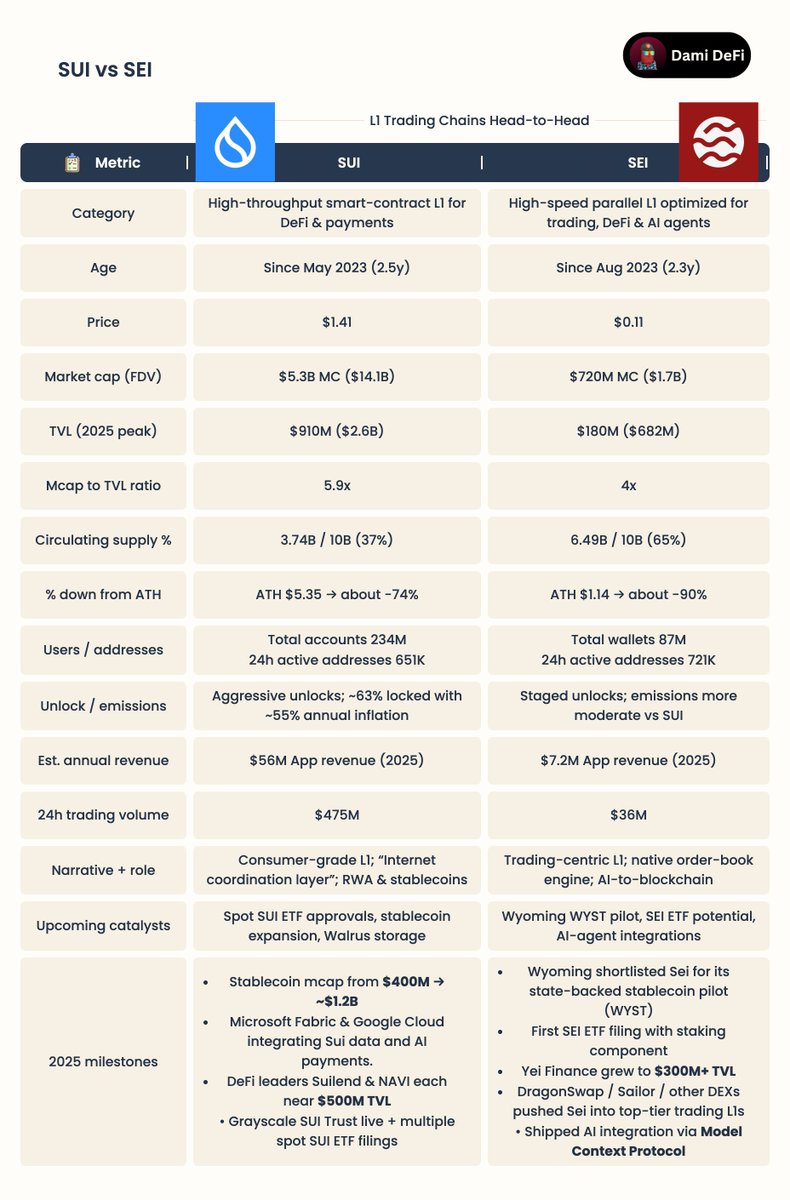
$SUI vs $SEI
[Head to Head Series #5]
$SUI to me feels like the more grown up play.
Bigger mcap, way higher app revenue, almost $1B TVL (after peaking at $2.6B), and a serious https://t.co/af2pXrsadO
Choosing your battlefield? Match hardware to workload. High VRAM beasts favor Render’s rendering marathons; versatile CUDA cores excel on io. net’s ML sprints. Test both with low-commitment nodes, tracking dashboards for hourly rates. Tools like GPU monitoring apps and auto-bid scripts amp efficiency, pushing passive income toward the upper earnings bands.
Scale comes from decentralization when you design for it.
For decentralized GPU marketplace comparison, Render edges in stability for creative pros, while io. net dominates volume for AI hustlers. Both crush centralized clouds on cost and access, with Solana migrations sealing low-fee deals. Providers stacking multiple GPUs across platforms diversify risks, capturing upside from RNDR’s 24-hour climb of and $0.0900 ( and 6.72%).
Get Started: Practical Steps for Idle GPU Rewards
Dive in without the fluff. Download wallets, stake minimal tokens for node registration, and verify hardware via benchmarks. Render demands OctaneRender compatibility; io. net scans for ML frameworks. Run 24/7 with UPS backups, and join Discords for job alerts. Earnings compound as networks mature, positioning you for 2026’s AI boom. I’ve seen swings where provider influx precedes 20% token pops- stay nimble.
Bottom line for earn passive income idle GPU Render io. net: Plug in now. With Render hitting $200k monthly and io. net doubling to $2.5M, idle silicon prints money in this DePIN gold rush. Monitor RNDR at $1.43, scale your nodes, and trade the volatility. The future of compute is decentralized- your GPU’s ticket is waiting.