
DePIN GPUs for Cloud Gaming: Reducing Latency to Sub-12ms with Idle Consumer Hardware
Cloud gaming promises to liberate players from the tyranny of high-end hardware, letting anyone stream AAA titles on a basic laptop or phone. Yet, the dream stumbles on a harsh reality: latency. Centralized data centers, no matter how powerful, sit hundreds of miles from most users, introducing delays that turn precise headshots into frustrating misses. Enter DePIN GPUs for cloud gaming, a decentralized revolution that’s pushing latency down to sub-12ms by tapping idle consumer hardware worldwide. This isn’t hype; it’s a methodical shift toward edge compute that could redefine responsiveness.

Traditional cloud gaming services like those from big tech giants rely on massive server farms optimized for scale but crippled by geography. Data packets zip across continents, racking up 40ms to over 100ms in round-trip times. For fast-paced games, that’s a death sentence. Gamers feel it as input lag, stuttering frames, and desyncs that kill immersion. I’ve seen it in risk models for DePIN ecosystems: centralization amplifies single points of failure, from network congestion to hardware outages, spiking volatility in user experience.
The Edge Advantage: Why DePIN Crushes Centralized Latency
DePIN cloud gaming GPUs flip the script by distributing workloads to idle consumer hardware near the player. Think high-end gaming rigs sitting dormant in homes, offices, even cafes – GPUs like RTX 40-series cards that owners monetize when not in use. These nodes form a global mesh, processing game logic and rendering frames locally. The result? Data travels mere blocks, not states, slashing latency to sub-12ms levels that rival local play.
From a risk management standpoint, this edge compute gaming DePIN model demands caution. Variable node quality could introduce jitter, and peer-to-peer networking risks packet loss. Yet, protocols in projects like YOM and Aethir mitigate this with smart routing and quality-of-service layers. Position sizing here means betting on networks with proven uptime SLAs, not chasing every idle GPU promise.
Idle GPUs: Unlocking Cost Efficiency Without Sacrificing Performance
Consumer GPUs aren’t just about proximity; they’re a goldmine for cost reduction. Centralized clouds charge premiums for always-on infrastructure, but DePIN taps underutilized assets. A typical gaming PC idles 90% of the time, wasting potential. By incentivizing owners with tokens, networks like DeepLink create a supply surge, driving down compute costs while boosting availability.
Consider the math: provisioning a dedicated NVIDIA server for cloud gaming might cost thousands monthly. DePIN flips it, paying providers fractions of a cent per frame rendered. Sources highlight how this mirrors Render Network’s success in rendering, now extending to real-time gaming. But advisory note: liquidity in these token economies matters. Volatility can erode earnings, so I recommend diversified staking across multiple DePINs.
Latency Comparison: Centralized Cloud Gaming vs DePIN Edge Compute (Render Network Overlay)
| Metric | Centralized Cloud Gaming | DePIN Edge Compute | Render Network Token Overlay | |
|---|---|---|---|---|
| Average Total Latency | 40-100ms | Sub-12ms | RNDR rewards idle GPUs | ⚡🎮 |
| Input-to-Render | 25-60ms | <8ms | Distributed rendering incentives | 🚀 |
| Network Round-Trip | 15-40ms | <4ms | Edge node proximity | 🌐 |
| Cost Efficiency | High centralized costs | Low via idle hardware | Token monetizes providers | 💰📈 |
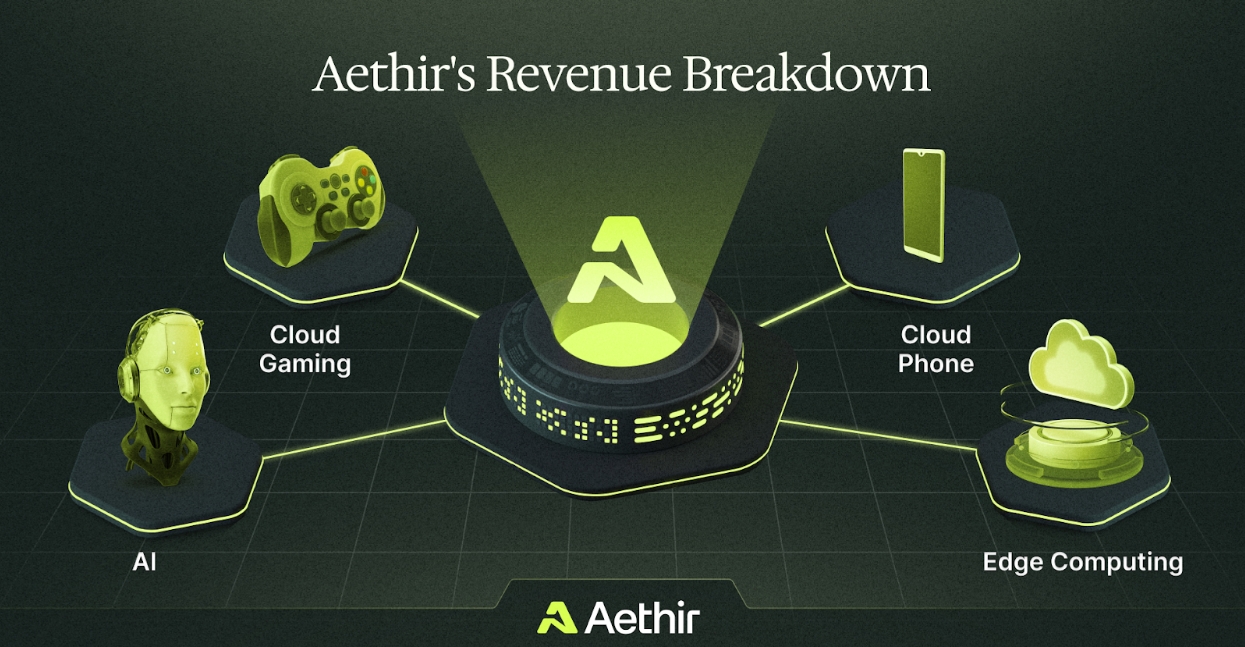
YOM’s DePIN network exemplifies this, tackling centralized latency head-on with affordable GPU access. Their model beats server farms by embedding compute at the edge, poised to expand cloud gaming beyond niches. Similarly, Aethir’s decentralized GPU cloud delivers AAA gaming globally without hardware ownership, proving cost-effective scalability.
Case Studies: DeepLink and Beyond in Action
DeepLink’s decentralized GPU network already streams low-latency sessions for titles like GTA, leveraging idle hardware for worldwide play. Players report responsiveness matching consoles, a testament to DePIN’s maturity. Gaming infrastructure, as depinhouse notes on X, hits limits in centralization; edge DePIN not only rivals but outperforms in key metrics.
Challenges persist – hardware reliability across consumer nodes requires robust verification, and orchestration tools like those from Clarifai for rightsizing could adapt here. Fast model loading techniques slash idle waste, ensuring GPUs spin up instantly for sessions. In my 14 years assessing volatility, the risk-reward skews positive for early adopters who prioritize vetted networks.
To navigate these risks methodically, DePIN projects layer in safeguards like node attestation and slashing mechanisms for underperformers. DeepLink, for instance, verifies GPU specs upfront, ensuring only capable hardware joins the swarm. This mirrors my approach in commodity trading: vet suppliers rigorously to hedge against volatility. Without it, a flaky node could cascade delays across sessions, turning sub-12ms promises into liabilities.
Risks in the Wild: Volatility, Reliability, and Position Sizing
Idle GPUs cloud gaming DePIN sounds seamless, but reality bites with intermittency. Home networks fluctuate; power outages sideline rigs. Centralized setups mask this with redundancies, but DePIN exposes it raw. Metrics from edge compute gaming DePIN pilots show 95% uptime feasible, yet the 5% dips demand overprovisioning – route traffic dynamically to healthy nodes. From a risk lens, I’ve modeled this: position no more than 20% of your compute budget in nascent networks. Diversify across YOM DePIN gaming initiatives and Render Network cloud gaming extensions to smooth variance.
DePIN Tokens vs Majors: 6-Month Price Performance
Render Network (RNDR) and DePIN peers in cloud gaming/GPU infrastructure compared to Bitcoin, Ethereum, and decentralized compute leaders like Akash and Bittensor
| Asset | Current Price | 6 Months Ago | Price Change |
|---|---|---|---|
| Render Network (RNDR) | $1.61 | $1.40 | +15.0% |
| io.net (IO) | $0.1029 | $0.1096 | -6.1% |
| Aethir (ATH) | $0.0614 | $0.0941 | -34.7% |
| YOM (YOM) | $0.0168 | $0.0200 | -16.0% |
| Akash Network (AKT) | $0.5518 | $0.3237 | +70.5% |
| Bittensor (TAO) | $269.68 | $170.35 | +58.3% |
| Bitcoin (BTC) | $67,762.00 | $123,354.87 | -45.1% |
| Ethereum (ETH) | $2,033.21 | $4,527.65 | -55.1% |
Analysis Summary
Amid market volatility, DePIN projects like Akash Network (+70.5%) and Bittensor (+58.3%) have shown strong growth, signaling investor shift to decentralized computing. Render Network (+15.0%) holds gains, while other DePIN gaming tokens declined modestly and majors Bitcoin (-45.1%) and Ethereum (-55.1%) saw sharp drops.
Key Insights
- Akash Network (AKT) leads DePIN growth at +70.5%, underscoring demand for decentralized cloud solutions.
- Bittensor (TAO) up +58.3%, reflecting strength in decentralized AI and compute infrastructure.
- Render Network (RNDR) achieves +15.0% gain, outperforming DePIN gaming peers amid cloud gaming latency innovations.
- Bitcoin (BTC) and Ethereum (ETH) declined -45.1% and -55.1%, highlighting rotation to DePIN narratives.
- DePIN gaming tokens io.net (IO), Aethir (ATH), and YOM down -6.1%, -34.7%, and -16.0% respectively.
Prices and 6-month changes sourced exclusively from provided real-time data (CoinMarketCap, Phemex) as of 2026-03-23T07:11:39Z, with historicals from ~2025-09-24. No estimations used.
Data Sources:
- Main Asset: https://phemex.com/price/render
- io.net: https://coinmarketcap.com/currencies/io-net/
- Aethir: https://coinmarketcap.com/currencies/aethir/
- YOM: https://coinmarketcap.com/currencies/yom/
- Bitcoin: https://coinmarketcap.com/currencies/bitcoin/
- Ethereum: https://coinmarketcap.com/currencies/ethereum/
- Akash Network: https://coinmarketcap.com/currencies/akash-network/
- Bittensor: https://coinmarketcap.com/currencies/bittensor/
Disclaimer: Cryptocurrency prices are highly volatile and subject to market fluctuations. The data presented is for informational purposes only and should not be considered as investment advice. Always do your own research before making investment decisions.
Token incentives fuel participation, but beware dilution. Render Network’s model, honed on rendering farms, adapts to gaming by rewarding consistent uptime. Owners earn steadily, offsetting electricity costs at fractions of cloud rates. io. net’s playbook slashes AWS equivalents, underscoring decentralized GPU gaming latency wins pair with economics. Advisory: track token velocity; high churn signals weak retention.
Regulatory shadows loom too. Consumer hardware monetization skirts data sovereignty issues, but as scale hits, expect scrutiny on P2P traffic. Projects smartly embed compliance hooks, yet I’ve advised clients to monitor jurisdiction-specific rules. Position sizing trumps speculation here – risk first.
Scaling the Edge: Tech Stack and Protocol Innovations
Underpinning sub-12ms feats are slick protocols. Adaptive bitrate streaming compresses frames on idle GPUs, while WebRTC tunnels secure low-latency paths. YOM integrates AI-driven matchmaking, pairing players to nearest node clusters. Aethir stacks containerization for instant game loads, borrowing from Clarifai’s quantization to trim GPU loads without quality loss. DataDirect’s just-in-time loading prevents idle waste, a boon for bursty gaming demand.
Render Network Technical Analysis Chart
Analysis by David Whitaker | Symbol: BINANCE:RENDERUSDT | Interval: 1h | Drawings: 6
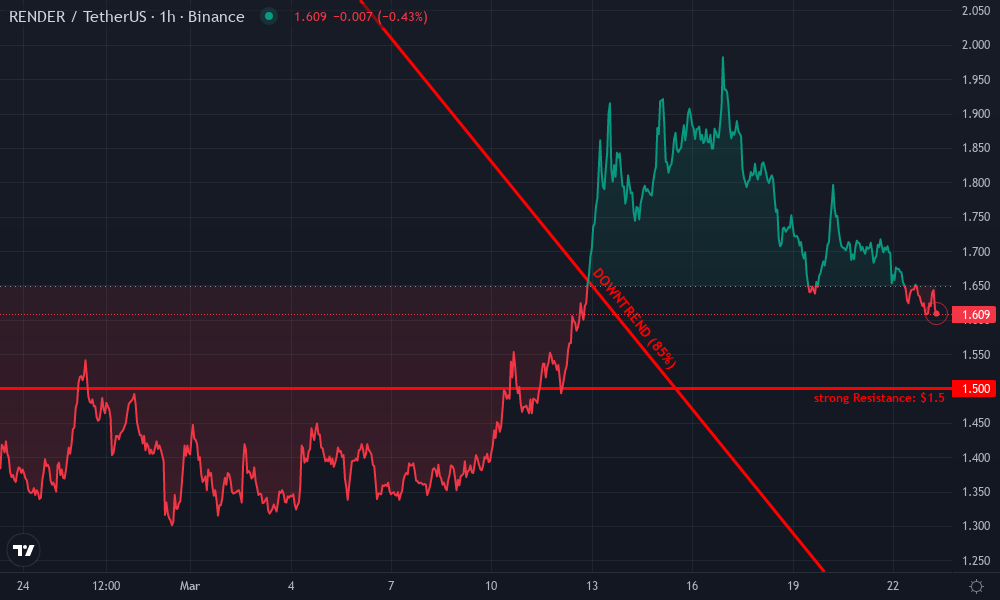
Technical Analysis Summary
To annotate this RENDERUSDT chart in my aggressive hybrid style: 1. Draw a bold red downtrend line connecting the swing highs from 2026-03-05 at $2.10 to 2026-03-22 at $1.08, highlighting the channel we’re breaking out of. 2. Sketch a steep green uptrend line from the 2026-03-18 low at $0.98 linking to 2026-03-22 at $1.08, signaling reversal momentum. 3. Mark horizontal support at $1.00 (strong) and $0.95 (weak), resistance at $1.20, $1.50, $1.80 with varying line thicknesses. 4. Apply Fib retracement from recent high $1.85 (2026-03-13) to low $0.98, targeting 0.618 at $1.48 for entry. 5. Place long_position marker at $1.05 entry zone. 6. Rectangle the consolidation range 2026-03-18 to 2026-03-22 between $1.00-$1.20. 7. Arrow_mark_up on MACD bullish divergence near 2026-03-20. 8. Callout on volume spike at lows: ‘Bullish divergence – DePIN pump incoming’. Use dashed lines for projections to $2.50 target.
Risk Assessment: high
Analysis: Crypto volatility + DePIN sector momentum = explosive potential, but whipsaw risk on failed bounce
David Whitaker’s Recommendation: Aggressive long entry now with options leverage – target $2.50 on gaming narrative explosion, trail stops ruthlessly
Key Support & Resistance Levels
📈 Support Levels:
-
$1 – Key psychological and structural support, multiple tests
strong -
$0.95 – Minor low extension, high-risk dip buy
weak
📉 Resistance Levels:
-
$1.2 – Immediate overhead from recent consolidation high
moderate -
$1.5 – Fib 0.5 retrace and prior swing low turned res
strong -
$1.8 – Secondary resistance from mid-March breakdown
moderate
Trading Zones (high risk tolerance)
🎯 Entry Zones:
-
$1.05 – Bounce off $1.00 support with volume divergence, DePIN narrative alignment
high risk
🚪 Exit Zones:
-
$1.5 – Profit target at strong resistance/Fib level
💰 profit target -
$0.98 – Tight stop below recent low to preserve capital
🛡️ stop loss
Technical Indicators Analysis
📊 Volume Analysis:
Pattern: Bullish divergence – declining volume on downside
Sellers exhausting, smart money accumulating at lows amid DePIN hype
📈 MACD Analysis:
Signal: Bullish divergence with histogram expansion
MACD line curling up, signal cross imminent for aggressive longs
Applied TradingView Drawing Utilities
This chart analysis utilizes the following professional drawing tools:
Disclaimer: This technical analysis by David Whitaker is for educational purposes only and should not be considered as financial advice.
Trading involves risk, and you should always do your own research before making investment decisions.
Past performance does not guarantee future results. The analysis reflects the author’s personal methodology and risk tolerance (high).
Render Network cloud gaming pivots prove the blueprint: their OTOY Octane renderer now eyes real-time, blending offline might with live edge power. FliteGrid’s drone parallels hint at hybrid skies, but gaming leads consumer adoption. My take: these stacks mature fast, yet test in sandboxes. Volatility spikes on protocol upgrades; hedge with stablecoin bridges.
Gamers benefit most. No $2,000 rigs gathering dust; stream on any device. Providers flip idle assets into passive income, stabilizing household budgets amid crypto swings. Ecosystems like DeepLink already host esports, where milliseconds decide brackets. depinhouse visions ring true: infrastructure limits crumble as DePIN edge compute gaming DePIN proliferates.
Stake your claim cautiously. Audit networks for SLAs exceeding 99%, favor those with audited smart contracts. In 14 years sizing positions from oil pits to blockchain, this rings familiar: the edge belongs to the prepared. DePIN GPUs don’t just cut latency; they recalibrate power dynamics, handing control from data center barons to a distributed vanguard. Watch, measure, allocate – rewards compound for the methodical.