
Fractional GPU Compute in DePIN: Kova Network Pay-Per-Second Model for AI Training

In the high-stakes arena of AI training, where every compute cycle counts, traditional cloud providers force developers to rent entire GPUs, even when a fraction suffices. This inefficiency drains budgets and idles hardware, a relic of centralized models ill-suited for the decentralized era. Enter fractional GPU compute in DePIN, spearheaded by Kova Network’s pay-per-second model, which slices resources precisely and aligns costs with actual usage, unlocking DePIN GPU marketplace efficiency for builders worldwide.

Kova Network redefines decentralized GPU AI training by enabling users to access micro-slices of GPU cores, vCPUs, and RAM by the GB-hour. Providers contribute rigs, servers, or even cloud VMs via a simple agent install, transforming spare capacity into revenue streams. This liquid compute paradigm packs multiple jobs per machine, boosting utilization to 80-95% while delivering verifiable Proof-of-Utilization (PoU) receipts for trustless settlements.
“With Kova’s fractional compute, paying per second for what I actually use just makes sense. It feels like how infrastructure should’ve worked from day one. ” – Kova Community on X
Breaking Free from Whole-Chip Waste
Consider a typical AI inference task or fine-tuning run that barely taps 20% of an A100’s power. Centralized giants like Runpod or AWS demand full-unit payment, leading to rampant underutilization. Providers sit on idle silicon, and consumers overpay by margins that compound over multi-hour jobs. Kova shatters this with MIG/MPS partitioning and software slicing, allowing true fractional GPU compute DePIN. Run training or inference on 20% of a chip, pay for exactly 20% – no more, no less.

From a strategic vantage, this model echoes macro shifts toward precision resource allocation, much like io. net’s decentralized AI training but with granular billing. My 20 years tracking infrastructure trends affirm: projects emphasizing multi-tenant packing and reputation routing, as Kova does, compound value over years. Providers report earnings up to 1.8x higher than single-tenant gigs, a testament to smarter economics in DePIN GPU marketplace efficiency.
Pay-Per-Second Precision Reshapes Cloud Dynamics
Kova’s billing ticks by the second, yielding up to 55% cost reductions per result and sub-2-minute start times. No vendor lock-in plagues users; a unified API spans thousands of providers, from personal setups to enterprise nodes. This fluidity empowers AI teams to scale without migration headaches, fostering a vibrant ecosystem.
Providers activate in minutes: install the Kova Agent, advertise slices, and watch jobs route via reputation scores. High-utilization targets minimize downtime, while PoU ensures tamper-proof records. For developers, it’s a game-changer in pay per second GPU DePIN, mirroring how spot markets democratized AWS but decentralized and finer-grained.
Kova Network GPU: Building Blocks of Liquid Compute
At its core, Kova leverages hardware-agnostic agents compatible with diverse setups, packing jobs intelligently across the network. This isn’t mere hype; community buzz and expert dives, like Akash. eth’s notes on fractional access upending full-unit norms, signal real traction. In a landscape crowded with Render’s rendering focus or io. net’s breadth, Kova carves a niche in micro-compute for AI workloads, promising sustained throughput as adoption scales.
Strategically, such innovations fortify DePIN’s assault on cloud monopolies. Patience here compounds, as networks hitting 80-95% utilization set the stage for exponential growth in decentralized compute.
Long-term horizons reveal why Kova Network GPU stands out: its Proof-of-Utilization receipts create auditable trails that settle disputes and build network trust, a fundamental absent in many nascent DePINs. Builders fine-tuning models or running batch inference gain sub-2-minute queue times, scaling fluidly without the procurement cycles of legacy clouds. This precision fuels decentralized GPU AI training at scales previously reserved for hyperscalers.
Quantifying the Edge: Costs and Utilization Side-by-Side
Traditional setups squander potential; a developer needing 20% of an H100 pays full freight, often watching 80% idle. Kova flips the script with multi-tenant packing, squeezing 4-5 jobs per GPU via MIG and MPS tech. The payoff? Users slash effective costs per result by up to 55%, while providers chase 80-95% utilization targets, netting 1.8x earnings over solo rentals.
Kova Network vs Traditional Cloud
| Feature | Traditional Cloud | Kova DePIN |
|---|---|---|
| Billing Granularity | Hourly/Whole Unit | Per-Second/Fractional |
| Cost Savings | Baseline | Up to 55% Reduction |
| Utilization Rate | 20-50% | 80-95% |
| Provider Earnings | Single-Tenant | 1.8x Multi-Tenant |
| Start Time | Minutes-Hours | <2 Minutes |
These metrics aren’t abstractions; they’re the scaffolding for DePIN’s maturation. In my analysis of macro infrastructure plays, networks optimizing idle assets like this mirror early cloud disruptors, but with blockchain’s verifiability layered in.
Providers: From Idle Rigs to Revenue Machines
Hardware owners install the Kova Agent on anything from a garage RTX 4090 to colo’d A100 clusters, listing slices in minutes. Reputation routing funnels premium jobs to reliable nodes, minimizing risk and maximizing throughput. No more fragmented marketplaces; one network aggregates thousands of providers, dynamically matching supply to AI demand spikes. This creates a flywheel: higher earnings draw more silicon, denser packing lowers user costs, accelerating adoption.
Contrast this with Render Network’s rendering niche or io. net’s broader AI push; Kova’s micro-compute focus targets the long tail of fractional needs, from indie devs prototyping LLMs to enterprises batching inference. Community sentiment echoes this precision: forums buzz with tales of rigs humming at 90% load, payouts ticking reliably per PoU-validated seconds.
Fractional GPUs. For Real. MIG/MPS and software slicing to pack many jobs per GPU. Works for both training and inference. – Kova Network on Instagram
For strategic investors eyeing DePIN GPU marketplaces, Kova exemplifies fundamentals over flash. Its unified API eradicates lock-in, letting teams swap providers mid-job if latencies shift. Over multi-year cycles, this interoperability cements network effects, much like how Akash pioneered sovereign cloud but now refined for AI’s compute hunger.

The workflow is simple.
Submit through API or dashboard. The scheduler matches capacity. The node runs the job. Then verification happens.
Each step is automated, transparent, and optimized for latency and cost. https://t.co/1WSl4QRwTK

Opaque billing is a major problem in cloud infrastructure.
Kova generates signed receipts for every job. These receipts prove what was used and how long it ran.
This creates audit-ready billing and financial clarity. https://t.co/0E2XR7zR2V

Interruptions are common in distributed systems.
Kova treats them as normal. With checkpointing, jobs resume elsewhere with minimal redo.
This reduces wasted compute and protects your budget. https://t.co/8BaXjYeyvM

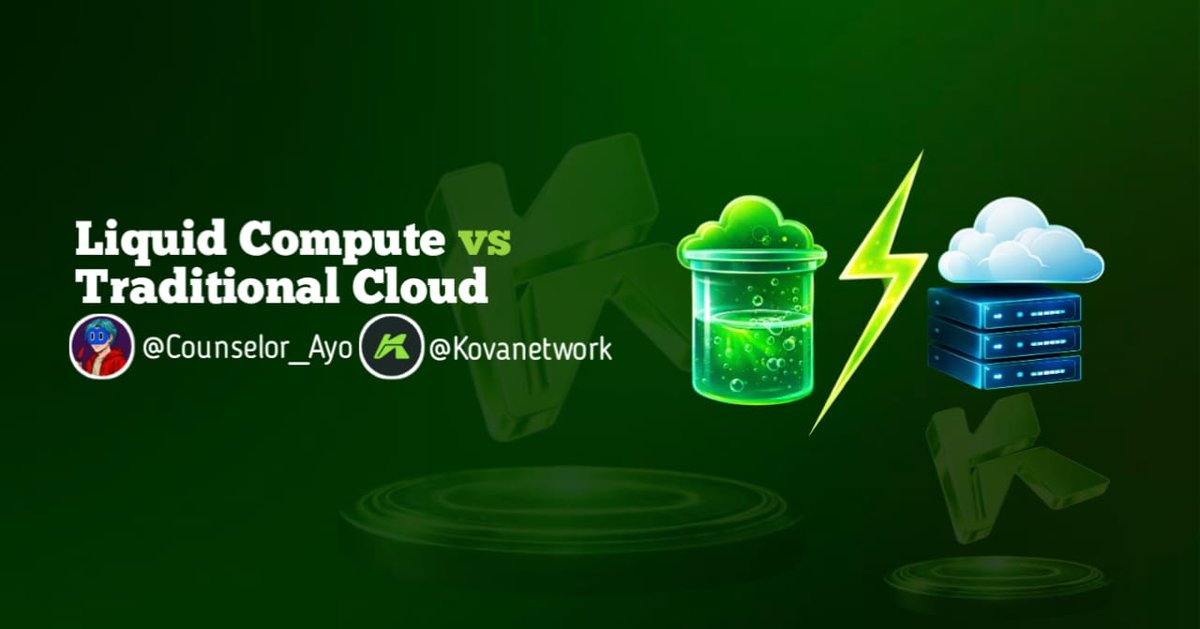
The traditional cloud is centralized and rigid.
Liquid compute is decentralized and dynamic. Resources flow where needed, based on latency and price.
Kova enables dynamic allocation across independent providers. https://t.co/ucgVvYy9FC
Providers install the Kova agent and stake KOVA.
Their hardware becomes part of the node network. Jobs are routed based on performance and reputation.
Higher uptime and reliability increase earnings potential. https://t.co/YqQiek2j7z

Not all nodes perform equally.
Kova tracks uptime, completion rate, and dispute rate. These metrics influence job routing.
This creates incentives for quality and reliability. https://t.co/YOinoMndGg

Imagine an AI startup processing small batches of images.
On traditional cloud, they rent a full GPU instance hourly. On Kova, they slice fractional GPU power and pay per second.
The result is lower effective cost per inference and faster time-to-start. https://t.co/XqXsoSnlPI
AI workloads are bursty and unpredictable.
They require flexible scaling, cost transparency, and resilience.
Kova’s decentralized, encrypted, pay-per-second model aligns with how modern AI systems operate.
Quick observation. If your compute strategy is still built https://t.co/Nukh7oeboX
Pay Per Second GPU DePIN: The Multi-Year Play
Zoom out, and fractional models like Kova’s signal a tectonic shift. Cloud economics, long distorted by overprovisioning, yield to liquid alternatives where utilization governs value. Providers earn steadily from underused assets; builders prototype without budget black holes. As AI workloads proliferate, from edge inference to massive pretraining, DePIN’s granular billing ensures scalability without monopoly rents.
I’ve watched trends compound over two decades: the winners blend tech with incentives. Kova’s PoU, agent simplicity, and packing smarts position it to capture share in a market projected to explode. Builders and owners alike stand to gain; join early, hold steady, and watch decentralized compute redefine efficiency.