

In 2026, owning a high-end GPU like the RTX 4090 no longer means watching it sit idle during off-hours. Decentralized Physical Infrastructure Networks (DePIN) have matured into robust ecosystems where you can rent idle GPU decentralized compute resources to AI developers, 3D artists, and researchers worldwide. Platforms aggregate these underutilized assets into scalable networks that rival AWS at a fraction of the cost, often delivering 50-70% savings on GPU compute. This shift not only generates DePIN GPU marketplace passive income but also aligns with the fundamental growth of blockchain-based infrastructure, where supply meets surging demand for AI training without centralized bottlenecks.

DePIN Fundamentals: Why Idle GPU DePIN Earning Beats Centralized Alternatives
From my vantage as a former Goldman Sachs analyst turned DePIN advocate, the appeal lies in fundamentals over hype. Traditional clouds like AWS charge premiums for reliability, yet DePIN platforms distribute risk across thousands of nodes, enhancing uptime through redundancy. Consider DePIN vs AWS GPU costs 2026: decentralized rates hover at $0.20-$0.50 per GPU hour for H100 equivalents, versus AWS's $2.50 and, based on real-time marketplace data. Providers earn tokens tied to actual compute delivery, fostering long-term value accrual. Platforms like gpumarketdepin. com exemplify this by connecting providers directly to consumers in a trustless environment, inspired by Render and io. net's proven models.
Security remains paramount; audited smart contracts and zero-knowledge proofs ensure jobs execute without exposing your data. Earnings compound passively as network effects amplify demand: AI firms flock to these pools for inference tasks, rendering explodes with metaverse builds, and scientific simulations leverage spot capacity. Yet patience prevails; volatility in token prices demands a hold strategy, much like undervalued infra plays in traditional markets.
Comparison of Top DePIN Platforms for Idle GPU Earning 🚀💰
| Platform | Earnings Model | Hardware Requirements | Daily Earnings Potential (RTX 4090) | Pros/Cons | |
|---|---|---|---|---|---|
| [DePINed](https://www.depined.org/provider?utm_source=openai) [Analysis](https://cryptoaiworld.com/depined-analysis) | 🚀 SuperCloud Network 🤖 AI & rendering tasks 🌐 Idle bandwidth sharing 📱 User-friendly app | Paid in $dUSD stablecoin 💰 Real yield from global compute usage | NVIDIA GPUs 🖥️ 8GB+ VRAM recommended ⚙️ CUDA cores 🏠 Consumer architectures | $3-5 (varies by demand & uptime) | **Pros:** 👤 Easy setup, 💵 Stable payouts, 🔒 Low risk **Cons:** 🌐 Uses bandwidth, 📈 Newer platform |
| [Render Network](https://render.network) [Analysis](https://cryptoaiworld.com/render-analysis) | 🎨 Decentralized GPU rendering 🖼️ Gen AI imaging 🕶️ Metaverse content 🔗 Blender/OctaneRender/Redshift integration | RENDER tokens 💰 Per frame/task rendered | NVIDIA GPUs only 🖥️ 4GB+ VRAM ⚙️ CUDA 11+ 🏗️ RTX/Quadro architectures | $3-5 (varies by jobs & competition) | **Pros:** 🚀 Established network, 🎥 High-demand creative work, 🌍 Global pool **Cons:** 📉 Token volatility, 🥊 Pro GPU competition |
| [io.net](https://io.net) [Analysis](https://cryptoaiworld.com/io-analysis) | 🧠 AI training & inference ☁️ Solana-based cloud 📉 Cost-effective vs centralized 🔓 Permissionless access | $IO tokens 💰 For renting compute to devs | NVIDIA high-end GPUs 🖥️ 16GB+ VRAM (e.g., 4090/A100) ⚙️ CUDA compatible ⚡ Solana optimized | $3-5 (varies by AI demand) | **Pros:** 🧑💻 AI boom demand, ⚡ Fast payouts, 📈 Growth potential **Cons:** 🔧 Technical setup, 📉 Token price risk |
Power draw matters; a 4090 idling at 300W can net $3-5 daily under peak demand, per community benchmarks on Reddit's r/gpumining. Benchmark your setup with tools like FurMark, then monitor thermals via HWInfo. Electricity costs? Factor 0.15/kWh rates; net margins often exceed 60% post-utilities.
Installation kicks off the process: Download clients from official sites, e. g. , DePINed's one-click app or Render's Octane node. Configure via web portals, setting caps on CPU/RAM usage to preserve local gaming. Register wallets for token payouts, enabling seamless bridging to stables if desired.
Network connection follows, verifying your node via proof-of-hardware challenges. Early adopters report 24/7 viability on consumer PCs, with remote management apps handling tweaks. This foundation positions you for sustained DePIN GPU marketplace passive income, scaling from one rig to clusters.
Once your node verifies successfully, the real work begins: sustaining output amid fluctuating workloads. Demand spikes during AI model fine-tuning cycles or metaverse asset rushes, pushing utilization rates above 80% for top providers. Yet, as with any infra play, discipline separates consistent earners from dabblers.
Mastering Monitoring and Earnings Optimization
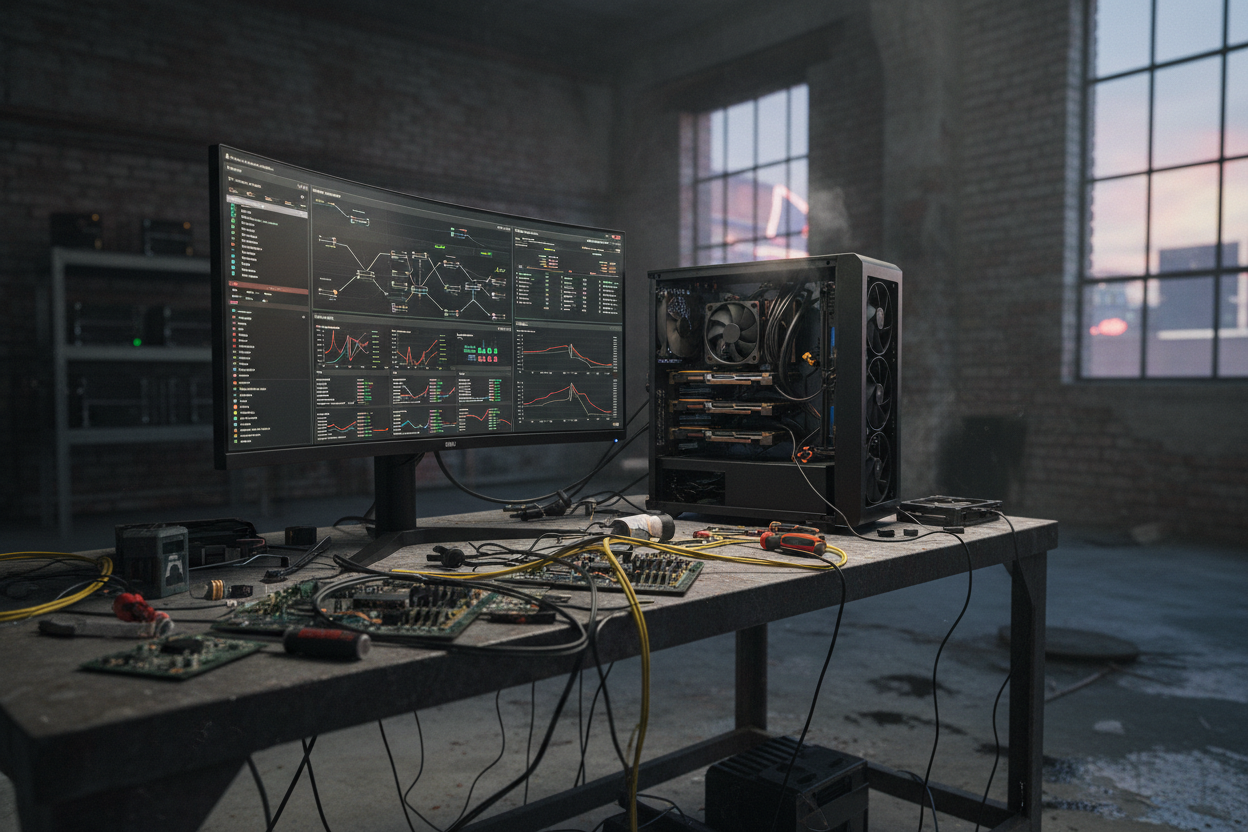
Step six, monitoring performance, demands tools beyond platform defaults. Integrate Prometheus for metrics or Grafana dashboards tailored to GPU loads; track hash rates, VRAM saturation, and rejection rates from faulty jobs. Aim for 95% and uptime to maximize idle GPU DePIN earning. Overheating? Throttle via MSI Afterburner curves, preserving hardware longevity over short-term gains.
Tracking earnings, the final step, reveals the payoff. Dashboards log tokens per hour, convertible to USD via integrated DEXes. For a RTX 4090, community data from ShareAI pegs $500 and annually at moderate use, scaling with clusters. Withdraw thresholds vary: DePINed's $dUSD flows daily, Render batches weekly. Bridge to stables or hold for appreciation, mirroring my long-term strategy in undervalued DePIN tokens.
Optimization elevates returns. Join provider pools for load balancing, or specialize: Render excels for ray-tracing workloads, io. net dominates AI inference with Solana speed. Hybrid setups, running multiple clients, capture diverse jobs but risk fragmentation; test sequentially first.
Real-World Earnings: Benchmarks and Pitfalls
Reddit threads in r/gpumining echo realities: a 4090 owner nets $4.20 daily on io. net during peaks, dipping to $1.50 off-hours, post-electricity. Aethir strategies highlight gaming rigs earning via cloud hosts, blending local play with remote renders. Forbes notes DePIN's edge in minimal effort, unlike staking's opportunity cost.
Pitfalls abound. Volatility strikes tokens; RENDER's cycles demand HODL conviction. Centralization creeps if top nodes dominate, though io. net's permissionless model counters this. Regulatory haze lingers, but blockchain transparency shields participants. Weigh electricity: at $0.12/kWh, a 450W rig costs $1.30 daily, yielding 65% margins.
Scaling transforms passive into portfolio-grade income. Start solo, expand to rigs via gpumarketdepin.com, the premier decentralized GPU marketplace aggregating providers like Render and io. net. List clusters there for premium bids, unlocking gpumarketdepin earn GPU at marketplace rates. My analysis favors diversified exposure: 40% Render for creative demand, 40% io. net for AI scale, 20% DePINed for stable yields.
Security protocols fortify participation. Platforms employ enclave tech, isolating jobs from your OS. Audit node software quarterly; use hardware wallets for payouts. Resource management balances local use: schedule gaming windows, reserving compute for nights.
Market dynamics favor 2026 entrants. AI compute hunger outpaces supply, with DePIN capturing 15% share per Bitrue trends. Tokenized devices via PopAI-like models tokenize capacity, trading fractions on secondary markets. Grassroots projects like XYO inspire, but GPU focus yields superior ROI.
Providers report lifestyle fits: gamers fund upgrades, hobbyists offset bills. Fundamentals dictate: select platforms with proven TVL, active devs, and real revenue. Patience accrues; early Render nodes compounded 10x since inception. In decentralized markets, idle GPUs evolve from expense to asset, powering the compute revolution while padding your wallet.

No comments yet. Be the first to share your thoughts!