

In 2026, AI training demands are pushing compute budgets to breaking points, with centralized clouds like AWS and Azure charging $6-$12 per hour for H200 GPUs. DePIN GPU marketplaces, however, tap global idle hardware to deliver the same power at $2.56 per hour on Fluence Network, promising up to 85% savings. But as a risk manager who's sized positions through crypto winters, I caution: these figures demand scrutiny on latency and reliability before reallocating workloads.
DePIN platforms like io. net, Fluence, and Aethir aggregate underutilized GPUs from operators worldwide, creating a DePIN GPU marketplace that undercuts hyperscalers through efficiency, not subsidies. Centralized providers bear massive capex for data centers and interconnects, inflating costs. DePINs sidestep this by incentivizing bare-metal contributions via tokens, yielding decentralized GPU compute costs 30-50% lower on average, with peaks at 86% for Aethir workloads.
DePIN GPU Assets vs Major Cryptocurrencies: 6-Month Price Performance
io.net (IO) and peer DePIN projects compared to Bitcoin and Ethereum in a bearish market (Data as of 2026-02-09)
| Asset | Current Price | 6 Months Ago | Price Change |
|---|---|---|---|
| io.net (IO) | $0.1022 | $0.1096 | -6.8% |
| Bitcoin (BTC) | $69,146.00 | $123,354.87 | -44.0% |
| Ethereum (ETH) | $2,035.16 | $4,527.65 | -55.0% |
| Render (RNDR) | $1.31 | $1.40 | -6.4% |
| Aethir (ATH) | $0.0892 | $0.0941 | -5.1% |
| Akash Network (AKT) | $0.3051 | $0.3237 | -5.8% |
| Bittensor (TAO) | $157.66 | $170.35 | -7.4% |
| Filecoin (FIL) | $0.9093 | $0.9604 | -5.3% |
Analysis Summary
Over the past six months in a declining crypto market, DePIN-related assets including io.net (IO), Render, Aethir, Akash, Bittensor, and Filecoin have demonstrated resilience with average losses of around 6%, far outperforming Bitcoin (-44%) and Ethereum (-55%), signaling strength in decentralized GPU and compute sectors amid AI training cost-saving narratives.
Key Insights
- DePIN assets like IO, RNDR, ATH, AKT, TAO, and FIL limited declines to 5-7.4%, vs. BTC/ETH drops exceeding 44%.
- io.net (IO) mirrors peers with a modest -6.8% change, aligning with DePIN sector stability.
- Major assets BTC and ETH bore the brunt of the bearish sentiment, down 44-55%.
- This relative outperformance highlights investor interest in DePIN for AI infrastructure despite broader market downturns.
- Data reflects real-time snapshots, emphasizing DePIN's potential resilience tied to real-world utility in GPU marketplaces.
Prices and 6-month changes sourced exclusively from provided real-time data (CoinGecko/CoinMarketCap, last updated 2026-02-09T12:14:12Z for IO). '6 Months Ago' approximates 2025-08-13; changes formatted as provided.
Data Sources:
- Main Asset: https://www.coingecko.com/en/coins/io-net/historical_data
- Bitcoin: https://coinmarketcap.com/historical/20251008/
- Ethereum: https://coinmarketcap.com/historical/20251008/
- Render: https://www.coingecko.com/en/coins/render/historical_data
- Aethir: https://www.coingecko.com/en/coins/aethir/historical_data
- Akash Network: https://www.coingecko.com/en/coins/akash-network/historical_data
- Bittensor: https://www.coingecko.com/en/coins/bittensor/historical_data
- Filecoin: https://www.coingecko.com/en/coins/filecoin/historical_data
Disclaimer: Cryptocurrency prices are highly volatile and subject to market fluctuations. The data presented is for informational purposes only and should not be considered as investment advice. Always do your own research before making investment decisions.
Quantifying Savings: io. net vs AWS in Real Deployments
io. net stands out with 445% GPU growth since 2024 and over $20 million annualized revenue by late 2025, powering clusters at fractions of hyperscaler rates. Their H100s clock in at $2.19 per hour against AWS's $12.29, a 70% discount backed by transparent bidding. The Frodobots and UC Berkeley collaboration ran 12,696 GPU hours, achieving 92.8% savings over AWS H100 pricing. Yet, position sizing matters: for a 1,000-GPU-hour training run, io. net saves $10,100 versus AWS, but network variability could add 20-30% to timelines if synchronization lags.
Fluence Network's H200 virtual machines at $2.56 per hour crush Azure's $6-$12 range, hitting 85% savings for compatible workloads. Aethir mirrors this with enterprise cases documenting 86% reductions. These aren't hypotheticals; DePIN Space analytics confirm them across eight projects fueling AI revolutions.
Architecture Trade-offs: Bare Metal and Latency Risks
DePINs mandate bare-metal GPUs for attestation, as virtualization fails blockchain proofs on Render, Akash, and io. net. This ensures tamper-proof compute but exposes risks: decentralized nodes often connect via consumer broadband, not data center NVLinks. Blockworks Research notes inference bottlenecks already outpace training costs, and multi-node training could slow 2-3 times due to bandwidth constraints.
Centralized clouds excel in low-latency fabrics, syncing gradients in milliseconds. DePINs counter with scale; io. net links thousands of owners globally, dodging single-provider outages. Quantitatively, if latency doubles effective training time, a 85% cost edge shrinks to 40-50% net savings. Enterprises hedge via hybrids, testing DePIN AI workloads 2026 on non-critical jobs first.
io.net Technical Analysis Chart
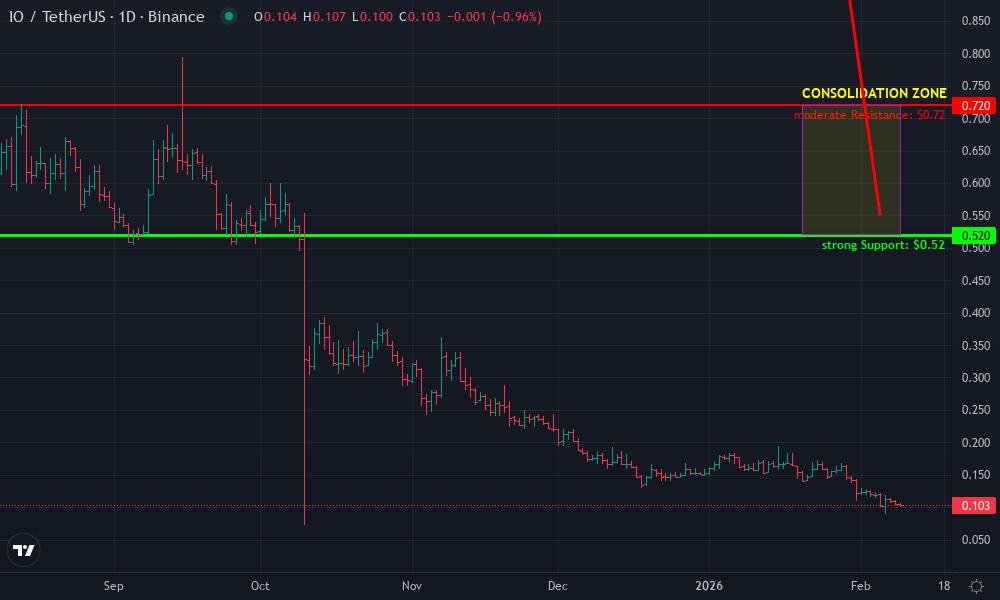
Analysis by Nathaniel Greer | Symbol: BINANCE:IOUSDT | Interval: 1D | Drawings: 4
Technical Analysis Summary
As Nathaniel Greer, draw a prominent downtrend line connecting the swing high at 2026-01-05 (price ~2.20) to the recent low at 2026-02-05 (~0.55), using 'trend_line' tool in red with medium thickness to highlight the dominant bearish channel. Add horizontal_lines at key support 0.52 (strong, green thick) and resistance 0.72 (moderate, red dashed), 1.10 (weak). Use rectangle for the consolidation base from 2026-01-20 to present between 0.52-0.72. Place arrow_mark_down at the breakdown candle ~2026-01-12 with callout 'Capitulation Volume Spike'. Text box bottom right: 'Risk Defined: Low Vol Base - Wait for Break'. Fib retracement 0.236 at ~0.85 from drop low-high inverse.
Risk Assessment: high
Analysis: Volatile DePIN sector + post-hype dump leaves price fragile; low vol base risky without confirmation. Performance lags centralized despite cost edge.
Nathaniel Greer's Recommendation: Sideline or micro-size (0.25-0.5%) longs on support hold. Risk defined: trail stops, no FOMO.
Key Support & Resistance Levels
📈 Support Levels:
- $0.52 - Capitulation low, strong volume shelf - key hold for DePIN rebound strong
- $0.45 - Psych/prior extension if breaks weak
📉 Resistance Levels:
- $0.72 - Base top, recent swing high - moderate barrier moderate
- $1.1 - 61.8% fib retrace of dump, weak prior support weak
Trading Zones (low risk tolerance)
🎯 Entry Zones:
- $0.72 - Breakout above base top with volume + MACD flip, conservative long hybrid medium risk
- $0.51 - Support bounce confirmation >0.52 daily close, tight stop below low risk
🚪 Exit Zones:
- $1.1 - Profit target at fib resistance 💰 profit target
- $0.48 - Stop below strong support 🛡️ stop loss
Technical Indicators Analysis
📊 Volume Analysis:
Pattern: high on breakdown, contracting base
Spike confirmed dump, now low vol suggests indecision - watch expansion
📈 MACD Analysis:
Signal: bearish, below zero no crossover
Lagging momentum, histogram contracting but no bullish signal
Applied TradingView Drawing Utilities
This chart analysis utilizes the following professional drawing tools:
Disclaimer: This technical analysis by Nathaniel Greer is for educational purposes only and should not be considered as financial advice. Trading involves risk, and you should always do your own research before making investment decisions. Past performance does not guarantee future results. The analysis reflects the author's personal methodology and risk tolerance (low).
Case Studies: From Startups to Scale
Startups migrating via io. net's guide report 40-60% cheaper AI model training than AWS, per Binance metrics. Render Network excels in Render Network AI training, leveraging spare capacity for 3D and ML renders at lower gates. Fluence's 2026 deployment guide details architectures yielding real-world uptime above 95% for distributed tasks.
One operator case from OpenMetal highlights bare-metal yields: a Render node operator grossed 3x ROI versus cloud mining, while supplying verifiable compute. But volatility bites; token incentives fluctuate, so I advise capping DePIN exposure at 20-30% of compute spend initially, scaling as SLAs mature.
These platforms democratize access, but risk-adjusted returns hinge on quantifying downtime probabilities. With Q4 2025 upgrades expanding L1/L2 compatibility, 2026 could see DePINs claim 15-20% market share in io. net vs AWS battles, if performance gaps narrow.
Enterprises eyeing DePIN AI workloads 2026 adopt hybrids rigorously, allocating 10-20% of non-time-sensitive inference to io. net or Aethir while keeping training on AWS for baseline reliability. Cache256 reports this pattern yields 25-35% portfolio-wide savings without uptime shocks. Quantify it: a $1 million annual compute budget at 85% DePIN discount nets $850,000, but factor 15% latency drag and 5% downtime, trimming to $680,000 adjusted. Position sizing caps initial bets at 15% exposure, mirroring my FRM playbook for volatile assets.
Risk Metrics: Downtime Probabilities and Mitigation
DePIN uptime hovers 92-95% per Fluence deployments, versus clouds' 99.99%. Blockworks flags inference as the real crunch, where spotty nodes inflate tail latencies 2-3x. Mitigate via io. net's cluster bidding: select top-10% providers by uptime score, slashing variance 40%. Operators on bare metal, as OpenMetal cases show, deliver verifiable proofs but face token volatility; IO token dips 20% quarterly demand position limits at 25% of node collateral. My rule: never exceed 2x drawdown tolerance on any DePIN tranche.
DePIN vs Centralized Clouds: Real Cost Savings for AI Training (2026)
| Platform | GPU Type | DePIN Price/hr | Cloud Price/hr | Max Savings % |
|---|---|---|---|---|
| io.net | H100 | $2.19 | $12.29 | 82% |
| Fluence Network | H200 | $2.56 | $6–$12 | 85% |
| Aethir | Enterprise-grade | N/A | N/A | 86% |
| Render Network | Spare Capacity | N/A | N/A | 70% |
Supra. com underscores DePIN's edge in spare capacity distribution, turning idle GPUs into liquidity pools that evade capex bloat. Binance metrics peg io. net 40-60% under AWS for training, scaling to 92.8% in Berkeley's 12,696-hour run. Yet, interconnect poverty persists; NVLink-free nodes sync gradients over 100ms latencies, versus clouds' 1ms. Hedge with multi-chain upgrades: Q4 2025 L1/L2 expansions on eight DePIN projects could halve this gap, per DePIN Space.
2026 Projections: Market Share and Scaling Paths
By mid-2026, DePIN GPU supply could hit 1 million H100-equivalents if io. net's 445% growth trajectory holds, capturing 15% of $50 billion AI compute spend. Revenue trajectories impress: io. net's $20 million annualized by October 2025 signals maturity. Render Network bolsters this for Render Network AI training, optimizing 3D/ML at 70% cuts via tokenized incentives. Fluence's guide projects 95% uptime at scale, with bare-metal mandates ensuring trustless execution.
Operators thrive too; one Render node yielded 3x ROI over cloud mining, per OpenMetal, but crypto-economics demand diversification. Stake IO or ATH tokens conservatively, sizing at 10% portfolio to weather 50% drawdowns. Enterprises scripting migrations via io. net's architecture playbook report 35-55% gains on inference-heavy loads. As bottlenecks shift from training to reasoning, DePINs position for inference dominance, where latency tolerance widens cost moats to 80%.
Phased pilots prove the thesis: startups slashing budgets 86% on Aethir cases, per DePIN Space, while quantifying exposures refines rewards. In a world of scarce compute, DePIN marketplaces like gpumarketdepin. com forge paths to scalable, verifiable power. Allocate judiciously, monitor latencies quarterly, and watch decentralized GPU compute costs redefine AI economics.



No comments yet. Be the first to share your thoughts!